How to Read Garment Care Labels: The Five Symbols Explained
Washtub, triangle, square, iron and circle: what each care symbol means, what the dots, bars and numbers tell you, and how to use them.
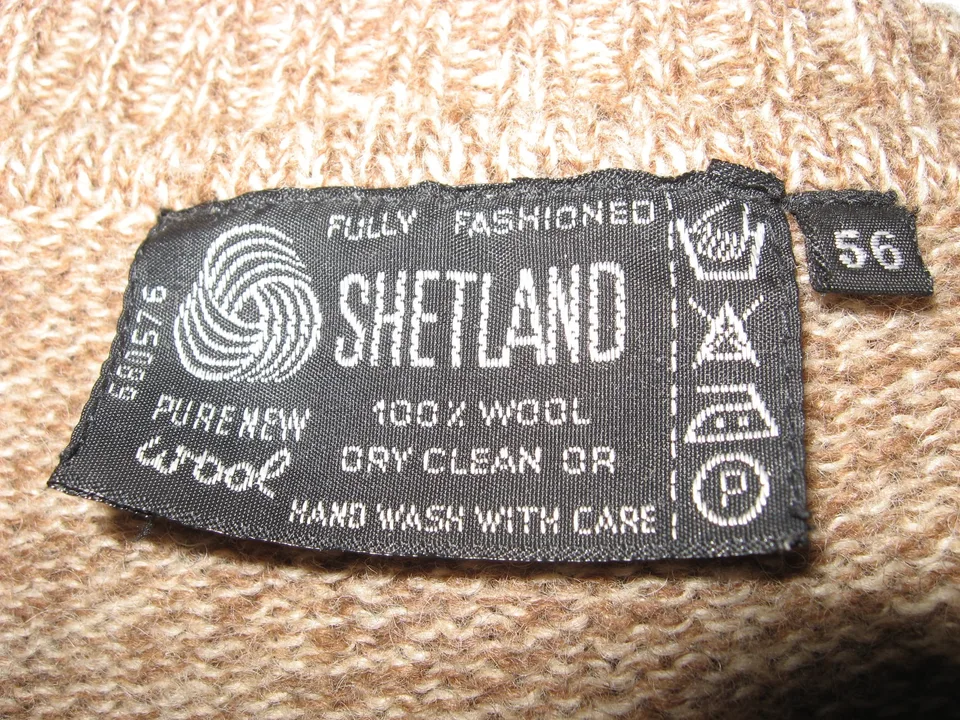
Photo: Elkagye, via Wikimedia Commons · Public domain (released by the author)
In short: a care label uses five basic symbols, usually in this order — a washtub for washing, a triangle for bleaching, a square for drying, an iron for ironing and a circle for professional cleaning. Numbers and dots show the maximum temperature, bars underneath mean "be gentler", and a cross means "do not".
The explanations below follow the international care symbols described by GINETEX, the International Association for Textile Care Labelling. The symbol system is also set out in the international standard ISO 3758. The label in the photograph above is from a wool jumper and is shown only as an example of how the symbols appear together.
The five symbols
Washtub — washing
- The number is the maximum washing temperature in degrees Celsius. It must not be exceeded; washing cooler is fine.
- One bar under the tub means a milder cycle with reduced mechanical action. Two bars mean a very mild cycle.
- A hand in the tub means hand wash only.
Triangle — bleaching
- Empty triangle: any bleach is allowed.
- Triangle with two oblique lines: only oxygen bleach is allowed, not chlorine bleach.
- Triangle with a cross: do not bleach; use a bleach-free detergent.
Square — drying
- A circle inside the square refers to tumble drying. Two dots allow normal tumble drying (80 °C); one dot means a mild process at a lower temperature (60 °C).
- The same symbol with a cross means do not tumble dry.
- Lines inside the square describe natural drying: a vertical line for line drying, a horizontal line for drying flat. An oblique line in the corner means dry in the shade.
Iron — ironing
The dots give the maximum temperature of the iron's sole plate:
- One dot: 120 °C. Steam ironing may cause irreversible damage at this setting.
- Two dots: 160 °C.
- Three dots: 210 °C.
GINETEX advises choosing the temperature from the care label rather than from the fibre content.
Circle — professional cleaning
The circle is for professional dry-cleaning or wet-cleaning. The letter inside tells the cleaner which solvents or process can be used, and a bar beneath it means a milder process is required. A crossed-out circle means the garment must not be professionally cleaned in that way. You do not need to memorise the letters — your cleaner reads them.
Three habits that suit most garments
These are general good practice, not a replacement for the label on your own garment:
- Treat the numbers as limits. The temperature on the label is the maximum, not a target.
- Wash similar colours together, especially when a strongly coloured garment is new.
- When there is no tumble-dry symbol, be cautious. GINETEX notes that the washing and ironing symbols then give a hint: the gentler those instructions, the more careful you should be when drying.
Care for your Mountain Explora polo
We have not published fabric or care details for the logo polo on the website yet, and we will not guess at them here. Follow the care label sewn into your garment — it always takes priority over general advice — and ask us if anything on it is unclear.
Frequently asked questions
What does the number in the washtub mean?
The maximum washing temperature in degrees Celsius.
What do the dots on the iron symbol mean?
The maximum sole-plate temperature: one dot 120 °C, two dots 160 °C, three dots 210 °C.
What does a bar under a symbol mean?
A gentler treatment. Under the washtub, one bar is a mild cycle and two bars a very mild one.
What does a cross through a symbol mean?
That the treatment is not allowed — for example, a crossed triangle means do not bleach.
Can I wash cooler than the label says?
Yes. The number is an upper limit.